One Brain to Rule Them All: Consolidating a Decade of Notes into Obsidian
If you’ve ever gone looking for a note and had to ask yourself, “Wait, did I put that in Roam, Reflect, TheBrain, or Evernote?”, this article is for you.
I spent the better part of 25 years building what I thought was a second brain. Turns out, I’d built five or six of them. Each one knew things the others didn’t. None of them talked to each other. And I was the unreliable bus driver trying to remember which brain held which memory.
Earlier this year, I finally did something about it. I consolidated everything (roughly 10,000 notes, thousands of PDFs, and contacts I’d forgotten I had) into a single Obsidian vault. Here’s how it went.
The Accumulation
My PKM journey started with TheBrain, and I genuinely loved it. There’s something magical about clicking into a node like “Trips” and watching all your vacations branch out visually in front of you. Over the years I accumulated around 4,000 thoughts in TheBrain, and I wrote about that experience in an earlier post.
But TheBrain had friction. Getting information in quickly was never its strength. I’d go weeks without opening it, and when a shiny new tool came along, I’d inevitably try it. Evernote became my web clipper and document dump: around 6,000 notes. Roam pulled me in with its outliner-style daily notes. Reflect caught my eye with its simplicity. WorkFlowy handled lists. Each tool was great at one thing, and I told myself the variety was a feature, not a problem.
It was a problem.
The Breaking Point
The breaking point wasn’t dramatic. It was a slow erosion of trust in my own system. I’d sit down to find something and realize I had no idea where it lived. The search wasn’t just across files; it was across apps. Open TheBrain. Open Evernote. Check Roam. Maybe it’s in Reflect? The cognitive overhead of maintaining mental indexes across five different tools was quietly eating the productivity these tools were supposed to create.
I also recognized a pattern I suspect many PKM enthusiasts share: I’d become a world-class collector of information but a mediocre retriever. I was building write-only databases: great at capture, rarely going back to use what I’d captured. The fragmentation made retrieval even harder, which made me retrieve less, which made the whole system feel less valuable, which made me less motivated to maintain it. A vicious cycle.
The Decision
I chose Obsidian for one reason above all others: markdown files on my local filesystem. After years of trusting proprietary formats and cloud-only tools, I wanted my notes in plain text files that I own. No more vendor lock-in. No more wondering what happens if a company shuts down or changes their pricing. If Obsidian disappeared tomorrow, I’d still have every single note as a readable .md file.
The other factors helped (the plugin ecosystem, the community, the speed), but the plain-text foundation was the non-negotiable.
Treating It Like a Program
I’ve spent my career managing large, complex programs. So when I stared down a migration involving five source systems and over 10,000 notes, I did what I know how to do: I treated it like a program.
I set up a vault called “My Second Brain” with a numbered folder structure loosely based on Tiago Forte’s PARA method (Projects, Areas, Resources, Archive), adapted to fit how I actually think and work:
- 0-Inbox: where everything lands first
- 1-Journal: daily notes and reflections
- 2-Active: current projects and areas of focus
- 3-Reference: things I want to find later
- 8-Archive: with subfolders per source system (TheBrain, Evernote, etc.)
- 9-PDFs: the document graveyard, now searchable
I intentionally skipped numbers in the sequence to leave room for future folders without disrupting the sort order. Small thing, but it’s saved me from reorganizing.
The Migration
Each source system had its own export quirks. Evernote’s export was relatively straightforward; Obsidian’s Importer plugin handled most of it. TheBrain was another story entirely. The JSON exports from TheBrain are dense and nested, and I’d never been able to make sense of them manually.
This is where AI changed the game. I used Claude to parse those JSON exports, and what had previously been an impenetrable wall of data became structured, importable notes. What I didn’t expect was the emotional side of it. Parsing years of old data turned into an unexpected trip down memory lane. I discovered roughly 2,000 contacts buried in my TheBrain export: people I’d worked with, met at conferences, connected with over the years. Names I hadn’t thought about in a decade suddenly resurfaced with context attached. It was like finding old photo albums in a digital attic.
Roam, Reflect, and WorkFlowy were smaller migrations, but each had its own format to wrangle. The key was being systematic: export, convert, import into the Archive folder tagged by source, then progressively sort and merge into the main structure.
Trimming the Fat
One of the best parts of the consolidation was the simplification of my Obsidian setup itself. My old vault had accumulated 26 plugins, many of which I’d installed to try once and forgotten about. I trimmed down to about five core plugins:
- Calendar: visual navigation of daily notes
- Dataview: querying my notes like a database
- Templater: consistent note structure
- Advanced Tables: because markdown tables are painful without it
- Importer: essential for the migration itself
Fewer plugins means fewer things to break on updates, less cognitive overhead in the interface, and a vault that opens fast.
The Infrastructure
A few practical decisions that made the whole system work:
Obsidian Sync replaced my previous approach of keeping the vault on OneDrive. Sync conflicts with cloud storage and Obsidian are well-documented headaches, and Obsidian Sync just works across devices.
Moved the vault to a dedicated drive. Getting it off OneDrive’s synced folder and onto my E: drive eliminated a whole class of problems.
Voice capture via Drafts app. I set up a workflow where I can dictate a thought on my phone and it lands in my daily note. This solved one of my oldest PKM problems: capturing ideas when I’m not at my desk.
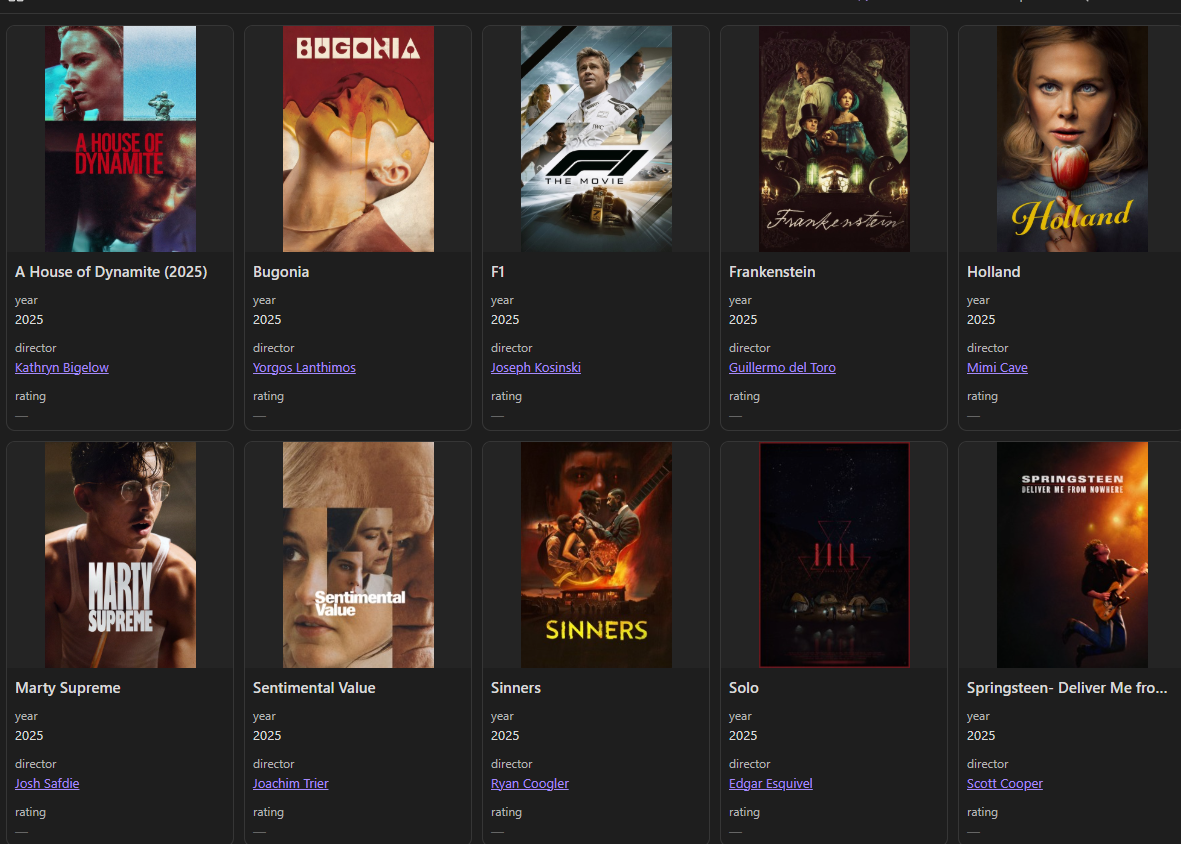
Bases for structured browsing. One of the things I missed most about TheBrain was the visual browsing: clicking into a topic and seeing everything related to it. Obsidian’s Bases feature has filled that gap in a different but surprisingly satisfying way. I now have bases for people, movies, actors, books, concerts, recipes, restaurants, and more. It turns my vault into something that feels less like a pile of notes and more like a personal database I can actually browse.
What I Learned
Consolidation is a project, not an afternoon. If you’re sitting on years of notes across multiple tools, respect the scope. Plan it out. Don’t try to do it in a weekend and burn out halfway through.
Plain text is freedom. Every proprietary format I’ve used has eventually become a migration headache. Markdown won’t.
Fewer tools, used consistently, beats many tools used sporadically. This sounds obvious, but it took me 25 years to actually internalize it. The best PKM system is the one you actually open every day.
The “write-only database” problem is real. Consolidation alone doesn’t fix it. You need retrieval habits, not just capture habits. But having everything in one place removes the biggest barrier to retrieval, which is knowing where to look.
AI is a legitimate migration tool. Parsing exports that would have taken weeks by hand took hours with AI assistance. If you’ve been putting off a migration because the data formats are ugly, that excuse is gone.
Where I Am Now
Everything is in one vault. I open Obsidian every morning. My daily note is my home base. When I need to find something, I search in exactly one place. The cognitive overhead of maintaining multiple systems is gone, and the difference is more noticeable than I expected.
I’m not going to pretend the system is perfect. I’m still refining how I organize and resurface older material. But for the first time in 25 years of PKM, I trust that when I put something into my system, I’ll be able to find it again. And that trust changes everything about how willingly you capture in the first place.
The consolidation also sparked something I didn’t expect: it inspired me to build Mind Like Water, a task and notes app where both are treated as first-class citizens. It syncs with an Obsidian plugin I built so you can manage GTD-style tasks right inside your vault, with everything flowing into the Mind Like Water web app. But that’s a story for another post.
If you’re reading this from the middle of your own tool fragmentation, take it from someone who’s been accumulating notes since before Evernote existed: the consolidation is worth it. Treat it like a project, pick a format you’ll never be locked out of, and just start.